Technical Interview Preparation · May 1, 2026
Technical Interview Prep for UK Innovator Visa Applicants: Top AI Tools & Techniques
Prepare for technical assessments in your UK Innovator Visa application with TorlyAI’s AI-driven coding practice and expert tips to showcase your expertise.


Gear Up for Your AI Technical Mock Interview
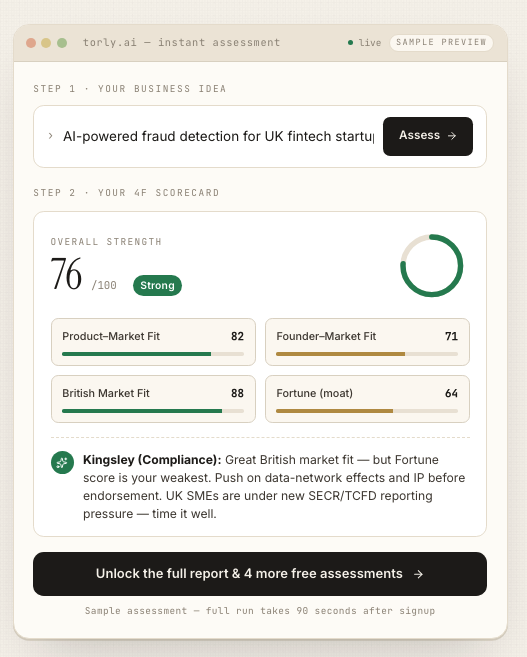
Preparing for the technical assessment of your UK Innovator Visa application can feel like climbing a steep mountain without a map. You need to prove your coding chops, design skills and problem-solving flair—often under pressure. That’s where an AI-powered approach steps in. By simulating real-world scenarios and offering instant feedback, you’ll transform stress into confidence. If you’re looking for an intuitive way to run an AI technical mock interview, you can start strong with AI-Powered UK Innovator Visa Application Assistant for AI technical mock interview right now.
Across this guide we’ll break down the core areas you must master, from algorithms and system design to behavioural insights. You’ll see how TorlyAI’s AI-driven coding practice and expert tips bring structure to your study plan. Whether you’ve just started sketching your business idea or you’re fine-tuning your pitch, this roadmap will help you showcase technical expertise and team-fit, boosting your chance of a smooth visa endorsement.
Why Technical Interviews Matter for Innovator Visa Applicants
A visa panel isn’t just checking your business idea; they want proof that you can handle the technical backbone of a scale-up venture. Solid coding skills, system design know-how and clear communication signal that you can lead a tech project in the UK’s vibrant startup scene. Neglect these, and you risk delays or refused endorsement.
With TorlyAI’s AI-driven coding practice, you can replicate the pressure of a live interview. The platform offers tailored problem sets aligned with Innovator Visa expectations, adaptive difficulty levels and scoring metrics that mirror Home Office standards. By the time you sit your real interview, you’ll be operating with clear data on your strengths and gaps.
Core Competencies Assessed
In a typical technical interview, assessors often look for:
- Technical proficiency: Your grasp of algorithms, data structures and code efficiency.
- System design sense: How you architect a scalable, maintainable application.
- CS fundamentals: Understanding CPU, memory, networking and database trade-offs.
- DevOps & AI literacy: Your comfort with cloud services, CI/CD pipelines and integrating AI tools.
- Behavioural alignment: Teamwork, coachability and resilience under stress.
Over the next sections, we’ll unpack each area with tips, examples and AI tools you can use to level up.
Mastering Algorithms and Data Structures
Algorithms and data structures are the bread and butter of coding assessments. Instead of memorising every LeetCode question, focus on patterns:
- Arrays, strings and linked lists for basic manipulation.
- Stacks, queues and heaps when you need ordering or prioritisation.
- Trees, graphs and hash tables for more complex relationships.
Your goal is to recognise which tool fits a problem, not just to recite code. When an interviewer asks, for example, “How would you detect a cycle in a graph?” explain your approach step by step. Talk about depth-first search vs breadth-first search, discuss Big O implications, and why you’d choose one method over another.
Pro tip: record yourself solving a problem, then compare your reasoning with TorlyAI’s feedback. The AI-driven practice highlights blind spots and suggests alternative patterns you might have missed.
Designing Robust Systems
At mid-career and senior levels, system design interviews dominate. You may be asked to design a simple version of Instagram, a messaging queue or a caching layer. Key concepts to review:
- Load balancing, caching and database sharding
- CAP theorem and consistency models
- Microservices vs monolith architecture
- Pub/sub systems and message queues
- Content delivery networks and reverse proxies
Don’t just memorise definitions—explain trade-offs. If you suggest caching, note the risk of stale data and how you’d handle invalidation. If you pick microservices, discuss deployment complexity and monitoring needs.
When you’re ready to practice, consider a hands-on desktop solution. Try out the TorlyAI Desktop APP for offline system design sketches and peer-review simulations.
Sharpening Computer Science Fundamentals
Even if you don’t code low-level device drivers, interviewers may probe:
- How memory management works in an OS
- The difference between TCP and UDP
- ACID properties in relational databases vs eventual consistency
- Design patterns like observer, factory or singleton
You don’t need encyclopaedic knowledge, but you should be able to link a concept to a real-world scenario. For instance, explain why you’d pick a CDN for static assets in an e-commerce site, or how an LRU cache could tighten response times in a payment gateway.
Embracing DevOps and AI
DevOps is the glue that holds modern applications together. Familiarise yourself with:
- Your targeted cloud provider’s core services (compute, storage, networking)
- CI/CD pipelines, container orchestration and infrastructure as code
- Monitoring, logging and alerting best practices
AI is no longer optional. Expect at least one question on how you’d integrate an AI service to solve a problem—be it natural language queries, anomaly detection or intelligent routing. Even if you haven’t built an AI model from scratch, you can demonstrate your knowledge by:
- Explaining how you’d use a pre-trained model in production
- Discussing data privacy and model monitoring
- Showing your ability to fine-tune prompts and handle bias
TorlyAI not only preps your coding skills but also simulates AI-enhanced scenarios so you can practise pivoting between code, infrastructure and AI components with confidence.
Build Your Endorsement Application with 6 AI Agents
Crafting a visa-ready business plan is just as crucial as coding skills. If you want a structured, AI-driven route to endorsement-ready documentation, consider the Build Your Endorsement Application with 6 AI Agents feature. It guides you through market analysis, team structuring and compliance checks—all in one place.
Nailing Behavioural and Cultural Fit
Technical prowess opens doors, but “culture fit” seals the deal. In behavioural rounds, apply the STAR method (Situation, Task, Action, Result) to questions like:
- “Describe a time you failed at a critical task.”
- “How have you resolved conflict in a team?”
- “Tell us about a design choice you led.”
Interviewers aren’t just checking boxes; they want to see if you’ll collaborate, take feedback and persist through setbacks. Frame your stories to highlight learning and adaptability. Show that you value shared success over solo heroics.
Structuring Your Study Plan
A scattergun approach rarely works. Instead, map out a weekly routine:
- Monday–Wednesday: Focus on data structures and algorithms.
- Thursday: System design practice with peer review.
- Friday: CS fundamentals deep dive—networks, OS and databases.
- Weekend: Mock behavioural interviews, using AI tools to simulate panel dynamics.
Regularly measure your progress with objective metrics—time taken per problem, design clarity scores and feedback from mentors. If you want a central hub to track all these elements, jump into an AI-Powered UK Innovator Visa Application Assistant for AI technical mock interview session around this halfway point in your prep.
Final Tips and Tricks
- Keep a “mistake log” to avoid repeating errors.
- Practice speaking your reasoning out loud, as you would in an interview.
- Pair-program with a friend or mentor to simulate live pressure.
- Tackle at least one surprise topic each week—be it DevOps, AI or a behavioural scenario.
And once your technical skills are polished, don’t overlook the business plan. You can also Build your Business Plan NOW using TorlyAI’s streamlined workflow for Innovator Visa candidates.
By combining focused study, AI-driven practice and a clear roadmap, you’ll enter your technical interview with poise. Good luck, and may your Innovator Visa journey be as innovative as your venture ideas.
Feeling ready? Start your AI technical mock interview practise with TorlyAI’s AI-Powered UK Innovator Visa Application Assistant