Country Specific Entrepreneur Visa Guides · August 12, 2026
Taiwan Entrepreneur Visa vs UK Founder Pathways: Assess Endorsement Readiness with Torly.ai
Compare international startup visas and evaluate your UK Innovator Founder Visa eligibility effortlessly using AI-Powered UK Innovator Visa Application Assistant.


Navigating International Startup Routes and Readiness
Expanding your startup globally is an exciting leap, but choosing the right host country can make or break your international expansion strategy. Both Taiwan and the United Kingdom offer specialized visa pathways designed to attract ambitious founders, yet their requirements, compliance standards, and strategic benefits differ significantly. While Taiwan provides a straightforward entry point into the Asian market with minimal initial friction, the UK Innovator Founder Visa offers direct access to a mature investment landscape, provided you can satisfy rigorous endorsing bodies regarding your business model’s innovation, viability, and scalability. Securing reliable Global Entrepreneur Visa Support early in your planning phase ensures you evaluate your options objectively and build a solid foundation for your application.
This comprehensive guide breaks down the core differences between the Taiwan Entrepreneur Visa and the UK Innovator Founder pathway. We examine eligibility criteria, residency duration, administrative hurdles, and long-term business potential for both regions. Furthermore, we explore how cutting-edge technology and intelligent business analysis can help you evaluate your endorsement readiness before committing significant time and capital. By understanding what endorsing bodies and immigration authorities expect, you can eliminate guesswork, address hidden gaps in your venture proposition, and significantly improve your probability of approval on the first attempt.
Taiwan Entrepreneur Visa: What You Need to Know
Taiwan launched its Entrepreneur Visa in 2015 to attract overseas creative talent and early-stage tech teams. It is specifically structured to reduce traditional bureaucratic friction for foreign founders looking to test products or build partnerships in East Asia.
Here are the key features of the Taiwan route:
* No immediate incorporation needed: You do not need to register a legal company in Taiwan before submitting your application.
* Residency terms: Successful candidates receive an initial residency period of up to two years, which can be extended from within Taiwan without departing the country.
* Group applications allowed: Up to three co-founders or core team members can apply under a single qualifying project.
* Qualifying criteria: Applicants typically need to show venture capital funding, incubators or accelerator participation, patent ownership, or notable design awards.
Taiwan serves as a vibrant launchpad for hardware innovation, semiconductor collaboration, and market validation in Asia. However, while the entry process is accessible, scaling a business across international borders eventually requires robust governance and broader corporate infrastructure.
UK Innovator Founder Visa: The High-Growth Standard
The UK Innovator Founder Visa is designed for ambitious entrepreneurs aiming to launch scalable, tech-driven, or high-impact businesses in Europe’s leading venture hub. Unlike entry routes that rely purely on personal capital or corporate sponsorship, the UK pathway hinges entirely on obtaining an official endorsement from an approved Endorsing Body (EB).
To secure endorsement, your business proposal must satisfy three core criteria:
1. Innovation: You must offer a genuine, original business plan that meets new or existing market needs and creates a competitive advantage.
2. Viability: You must demonstrate that your business strategy is realistic, with clear financial planning, achievable targets, and proof of founder capability.
3. Scalability: You need evidence of structured planning for job creation, market expansion, and national or international growth.
The UK pathway provides a direct three-year route to Indefinite Leave to Remain (ILR), making it standard for high-growth tech founders. However, meeting the high standards set by endorsing bodies can be tough without TorlyAI BP Builder APP to help structure your financial projections and strategic narrative.
Head-to-Head Comparison: Taiwan vs UK Entrepreneur Visas
Choosing between Taiwan and the UK depends on your target market, funding requirements, and operational goals. Both regions offer clear advantages, but their compliance standards differ dramatically.
| Feature | Taiwan Entrepreneur Visa | UK Innovator Founder Visa |
|---|---|---|
| Initial Grant | Up to 2 years | 3 years |
| Pre-Incorporation | Not required prior to visa approval | Not strictly required, but concept must be fully validated |
| Co-Founder Limit | Up to 3 applicants per team | Individual endorsement required for each founder |
| Approval Mechanism | Government agency review (MOEA) | Approved UK Endorsing Body (EB) review |
| Settlement Pathway | Permanent residency after 5 continuous years | Indefinite Leave to Remain (ILR) available after 3 years |
| Capital Requirement | Flexible; proven ecosystem support matters | No fixed minimum, but sufficient funds to execute business plan are required |
While Taiwan offers a lower barrier to entry for early testing, the UK delivers faster access to permanent settlement and deep venture capital pools. The primary challenge for the UK route lies in convincing private sector evaluators that your business model is bulletproof.
Assessing Your Endorsement Readiness for the UK Market
Most failed UK visa applications do not founder on personal credentials, they fail because the underlying business plan fails to satisfy commercial scrutiny. Endorsing bodies review hundreds of pitch decks and strategic plans every month. They quickly identify weak market research, unrealistic revenue growth assumptions, or vague intellectual property claims.
Before submitting an application, you must critically evaluate three main areas:
* Market Fit and Differentiation: Is there documented demand for your product? Have you clearly defined how your offering beats existing market alternatives?
* Financial Logic: Are your cash flow forecasts backed by reasonable assumptions? Do you have realistic customer acquisition costs and pricing models?
* Founder Capability: Can you prove that your professional background equips you to lead this venture successfully?
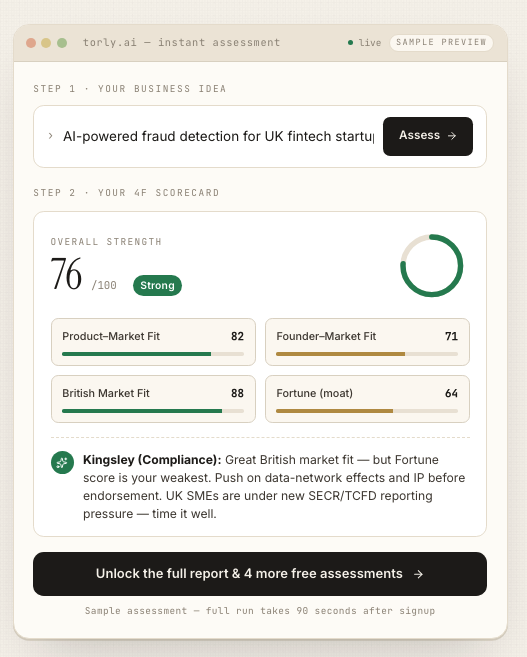
Checking these points manually can take months of back-and-forth consultation. Using dedicated digital tools like Build Your Endorsement Application with 6 AI Agents lets you evaluate your strengths and target specific weaknesses before submitting documents to an official panel.
How AI Transforms Your Visa Application Journey
The modern immigration landscape is shifting from slow, manual consultancies to dynamic, technology-driven tools. Preparing detailed visa business plans, operational frameworks, and compliance matrices requires precise alignment with updated Home Office guidelines.
Advanced AI platforms act as intelligent analysts rather than basic document templates. By running multi-layered evaluations across your business concept and founder background, artificial intelligence offers:
* Instant Gap Identification: Highlighting missing operational details, unverified financial projections, or weak competitive analyses.
* Continuous Rule Alignment: Ensuring all materials adhere to current UK Home Office policy and evolving endorsement trends.
* Targeted Action Plans: Generating clear, step-by-step guidance to strengthen every section of your portfolio.
Using Global Entrepreneur Visa Support solutions driven by specialized reasoning engines gives you the clarity needed to navigate complex immigration rules with confidence.
Bridging Gaps in Your Business Model with Intelligent Analysis
A strong business idea is not enough on its own; it must be framed precisely to match what assessors are looking for. Many founders struggle to translate technical ideas into commercially compelling narratives.
Common errors include:
* Overemphasizing technical features while ignoring go-to-market strategies.
* Underestimating UK operational costs and local hiring requirements.
* Failing to demonstrate clear scalability beyond localized service provision.
By utilizing dedicated evaluation tools, you can stress-test your market assumptions and refine your operating model early on. Accessing specialized tools to Build your Business Plan NOW ensures that your operational strategy, tech stack, and growth timelines align with endorsing body expectations.
Practical Steps to Take Before Applying
Preparing an international visa application requires methodical execution. Whether you decide to target Taiwan’s tech ecosystem or build a scale-up in the United Kingdom, following a structured preparation checklist will save you time and money.
Here is a practical roadmap to get started:
1. Define Your Primary Market: Determine whether your immediate revenue opportunities lie in Asia-Pacific hardware and production networks or Western venture capital and enterprise SaaS markets.
2. Audit Your Intellectual Property: Ensure your technology, branding, and proprietary processes are protected or clearly documented.
3. Conduct Objective Readiness Checks: Use automated evaluation software to run simulated assessments of your business plan and founder profile.
4. Refine Financial Models: Build transparent three-to-five-year financial forecasts that clearly outline unit economics, hiring plans, and working capital needs.
5. Assemble Supporting Evidence: Gather reference letters, commercial contracts, academic credentials, and evidence of prior entrepreneurial achievements.
Taking an objective, data-led approach to your application drastically reduces the risk of rejection. If you are aiming for the United Kingdom, leveraging dedicated platforms for Global Entrepreneur Visa Support provides the precise insights, feedback, and structural support required to turn your business concept into an endorsement-ready application package.