Clinical Trial Analytics · May 16, 2026
Leveraging Clinical Trial Predictive Analytics to Forecast Your Innovator Visa Endorsement
Learn how methodologies behind clinical trial success predictions can inform and improve your UK Innovator Visa endorsement chances with Torly.ai.


A New Prescription for Visa Success
Imagine you could apply the same rigour that top pharmaceutical firms use to predict trial success to your Innovator Visa endorsement. Clinical trial analytics visa methods have grown sophisticated. They sift massive datasets. They flag risks early. And they forecast outcomes with impressive accuracy.
Now picture an AI agent doing that for your UK Innovator Visa application. Assessing your business idea. Analysing your background. Highlighting gaps. All before you submit. That’s the promise of clinical trial analytics visa insights for entrepreneurs. AI-Powered clinical trial analytics visa assistant is your first step towards a data-informed endorsement strategy.
Understanding Clinical Trial Analytics and Its Visa Parallels
Clinical trial analytics involves statistical modelling, real-time monitoring and predictive outcomes. In medical R&D, this can mean the difference between halting a Phase II trial or advancing to Phase III. Take LivaNova’s OSPREY study as an example. Researchers used early predictors to forecast safety and efficacy before the final endpoint. That saved time, cut costs and minimised risks.
Why does that matter for your Innovator Visa? Visa endorsement follows a cycle: proposal, review, feedback, decision. Each stage produces data. You can analyse timelines, success rates and reviewer notes. Just as trial statisticians do. Here’s how the analogy stacks up:
- Protocol design ↔ Business model structure
- Sample size estimation ↔ Team size and founder experience
- Interim analyses ↔ Milestones in your pitch deck
- Final efficacy ↔ Endorsing Body decision
By borrowing from trial analytics, you turn intuition into evidence. You prove viability. You anticipate objections. You refine your plan long before the Home Office casts a verdict.
Drawing Parallels: From Trial Methodologies to Visa Endorsement
Let’s break down common trial techniques and their visa counterparts:
-
Predictive Modelling
– Trials: Logistic regression or machine learning to forecast patient response.
– Visas: Scorecard algorithms estimating endorsement likelihood based on past applications. -
Interim Analysis
– Trials: Periodic checks to decide if the study continues.
– Visas: Mid-application reviews, refining documents before the formal submission. -
Risk-Benefit Estimation
– Trials: Balancing possible side effects against therapeutic gains.
– Visas: Balancing market risk and innovation against regulatory requirements. -
Adaptive Design
– Trials: Altering study parameters based on interim findings.
– Visas: Pivoting your business proposition if early feedback suggests gaps.
These techniques aren’t buzzwords. They’re battle-tested. Now they’re within your reach.
How Torly.ai Applies Predictive Analytics to Visa Endorsements
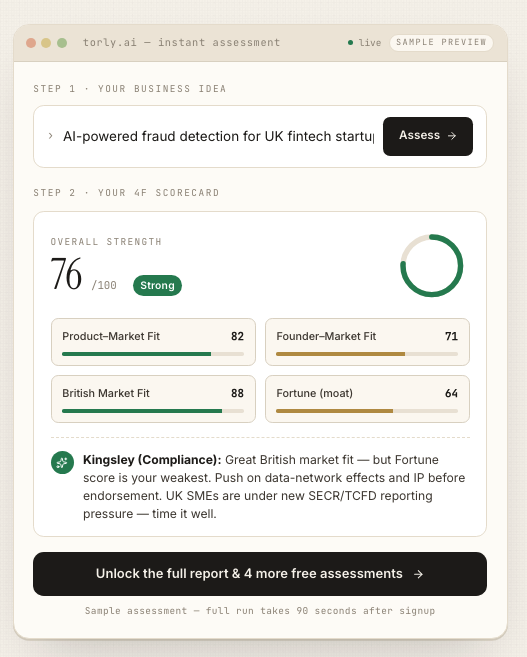
Torly.ai marries clinical trial rigour with immigration expertise. Here’s what happens when you engage the platform:
-
Business Idea Qualification
Torly.ai assesses innovation, viability and scale. It benchmarks your concept against endorsing body standards. -
Applicant Background Assessment
It analyses your CV, track record and domain expertise. It predicts how strongly you’ll score on founder capability. -
Gap Identification & Action Roadmap
You get a clear list of missing elements. Market insights. Tech stack tweaks. Team adjustments. Compliance checks.
All powered by advanced reasoning agents. The result? A bespoke visa readiness report in under 48 hours. No more guesswork. More confidence. And a plan you can trust. Build your Business Plan NOW
Step-by-Step: Implementing Trial Methodologies in Your Application
Borrow these trial-inspired steps for your Innovator Visa strategy:
-
Data Collection
Gather past Innovator Visa endorsement data. Look at success rates, common feedback points and processing times. -
Hypothesis Setting
Define what “success” means for your application. Higher endorsement score? Faster review? Clear market proof? -
Modelling & Simulation
Use simple predictive tools (even Excel) to run scenarios. How does adjusting team size affect your predicted outcome? What if you change your tech focus? -
Interim Reviews
Share a draft dossier with mentors or peer communities. Get real-time insights. Refine, then resubmit. -
Final Analysis & Submission
Confirm all criteria are satisfied. Submit with confidence, knowing your data analysis backs every claim.
These steps map precisely to established clinical trial patterns. And they sharpen your strategy.
Integrating Real-Time Feedback: The Power of AI Agents
In trials, real-time data monitoring prevents costly missteps. In your visa journey, Torly.ai’s AI agents act similarly:
- 24/7 availability.
- Immediate scoring updates as rules evolve.
- Contextual advice: tighten your pitch, adjust your financial forecasts, enrich your market research.
With these insights, you can:
- Anticipate common EB concerns.
- Respond faster to document requests.
- Optimise your submission schedule.
No more last-minute scrambles. Just a smooth, data-driven pathway to endorsement. Discover our clinical trial analytics visa tool
Case Study: Forecasting Endorsement Outcomes
Meet Sofia. A biotech entrepreneur from Madrid. She had a solid concept but struggled with EB feedback on market research. Using Torly.ai, she:
- Input her draft business plan.
- Ran a predictive endorsement model.
- Discovered her market study lacked UK-specific references.
- Updated her research, adding homegrown case studies.
- Increased her endorsement probability from 58% to 87%.
The endorsement body praised the depth of her analysis. She landed an Innovator Visa in just six weeks.
Tips to Optimise Your Application Using Data Insights
- Segment your audience: Just like clinical subgroups, tailor sections for investors, partners and regulators.
- Use visual analytics: Charts and dashboards speak louder than text.
- Prioritise early warnings: If an algorithm flags low market traction, address it first.
- Iterate often: Rapid cycles beat big monolithic updates.
These small habits compound into major endorsement gains.
Real Entrepreneurs Speak: Success with Torly.ai
“I never knew where to start with UK-specific market data. Torly.ai’s recommendations were spot on. My gap list was clear, actionable and precise.”
— Lucas N., FinTech Founder
“The way Torly.ai mimics clinical trial checks was a revelation. I felt like a trial principal investigator; every step was evidence-based.”
— Priya K., HealthTech Entrepreneur
“Submitting our Innovator Visa was the easiest part. The platform’s 48-hour turnaround meant we nailed the final draft with room to spare.”
— Ahmad E., Software Innovator
Conclusion: From Clinical Trials to Visa Triumph
You don’t need a PhD in biostatistics to leverage clinical trial analytics visa principles. You need the right tools. Torly.ai brings proven predictive analytics to your doorstep. It transforms data into clear action, minimises risk and forecasts endorsement success.
Ready to see your Innovator Visa outcome in numbers, not guesswork? Transform your application with clinical trial analytics visa insights