H1B Occupations Guide · May 8, 2026
H-1B vs UK Innovator Founder Visa: Choosing the Best Path for Your Startup
Compare H-1B and UK Innovator Founder Visas to identify the optimal route for your business venture with AI-driven insights from Torly.ai.

Kickstarting Your Global Startup Journey
Starting a business abroad is thrilling and full of traps. On one hand, there’s the well-trodden H-1B specialty occupation route in the United States. On the other, the UK Innovator Founder Visa offers a modern, innovation-driven alternative. This article is your go-to startup visa comparison, helping you weigh eligibility, costs, timelines and the support you actually need.
You’ll find clear pros and cons for each route. You’ll learn practical steps. And you’ll discover how Torly.ai’s AI-powered platform can give you an edge when applying for the UK Innovator Founder Visa. Ready to deep-dive yet stay on the sharp edge of efficiency? Discover our AI-Powered UK Innovator Visa Application Assistant for startup visa comparison
What Are the H-1B and Innovator Founder Visas?
When it comes to a startup visa comparison, the first step is understanding the fundamentals of each path. Let’s break them down.
H-1B Specialty Occupation Visa (USA)
- Designed for professionals in “specialty occupations” like engineering, finance or IT.
- Requires sponsorship by a US employer.
- Annual cap limits (85,000) and lottery selection can make it competitive.
- Initial validity: up to three years, extendable to six.
UK Innovator Founder Visa
- Geared towards founders with an innovative, scalable business idea.
- No sponsorship by a third-party employer; you self-sponsor.
- Must secure endorsement from an approved endorsing body.
- Valid for three years, with options to extend and settle.
Both visas demand evidence of professional or entrepreneurial excellence. But the Innovator Founder Visa emphasises innovation and scalability, rather than a job offer. That makes it a top pick in many startup visa comparison scenarios.
Eligibility Criteria and Application Steps
Your choice will hinge on strict requirements and the process ahead.
H-1B Requirements at a Glance
- Confirm your role qualifies as a specialty occupation.
- Secure a US employer willing to sponsor.
- File Form I-129 with USCIS, along with:
– Labour Condition Application (LCA) approval.
– Degree and professional credentials. - Enter the annual lottery (if applicable).
- Await approval, then apply for your visa stamp at a US consulate.
Innovator Founder Visa Requirements
- Develop an innovative, viable and scalable business proposal.
- Gain endorsement from an approved endorsing body.
- Demonstrate:
– £50,000 investment funds (or third-party funding).
– English language proficiency.
– Enough personal savings for living costs. - Submit your visa application online, along with endorsement letter.
- Prepare to show business planning, market research and financial forecasts.
This clear startup visa comparison shows the H-1B is employer-centric and competitive, while the Innovator Founder route is founder-led and endorsement-centric.
Evaluating Cost, Timeline and Approval Odds
Choosing the right route isn’t just about eligibility. You need to compare practical factors.
Processing Time
- H-1B: Lottery opens in April; approvals by October for the fiscal year. Premium processing trims it to 15 calendar days.
- Innovator Founder: Standard decisions take around 8 weeks. Priority processing can reduce timeline.
Fees and Financial Commitments
- H-1B: Filing fees from $1,500 to $6,000+ (depending on employer size), plus consulate stamping.
- Innovator Founder: £1,036 application fee plus Healthcare Surcharge (~£624/year). Endorsing body fees vary.
Chances of Success
- H-1B: Subject to cap and lottery; even top candidates may miss out.
- Innovator Founder: No lottery. Success rides on the strength of your business plan and endorsement.
The key takeaway in any startup visa comparison is your control over the process. The H-1B relies on an employer and draws on chance. The Innovator Founder Visa puts you in the driving seat, provided you nail the business case.
How Torly.ai Supercharges Your Innovator Founder Visa Application
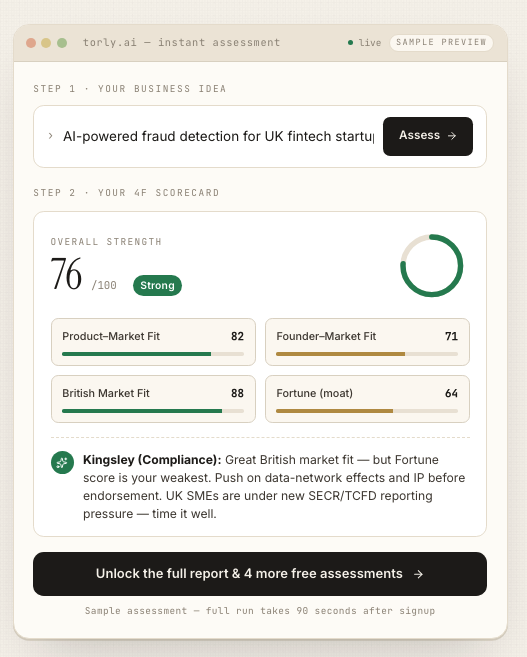
If you lean towards the UK route, Torly.ai is designed for founders just like you. Here’s how it works:
-
Business Idea Qualification
An AI-driven check against Home Office and endorsing body benchmarks. No guesswork on innovation and scalability. -
Applicant Background Assessment
An expert-level review of your skills and experience to boost endorsement prospects. -
Gap Identification & Action Roadmap
Targeted recommendations to plug weaknesses in your model, technology stack, team structure and more.
All delivered in under 48 hours, with real-time feedback and continuous improvement. And you can see it for yourself if you want:
Building an Endorsement-Ready Business Plan
A detailed plan is non-negotiable. Torly.ai’s BP Builder desktop app guides you through:
- Market analysis frameworks.
- Financial forecasting templates.
- Investor-grade pitch decks.
It even aligns content to the endorsing body’s criteria. Need it on your machine? Download our BP Build Desktop APP
Real-World Comparisons: Which Path Fits Your Startup?
Let’s apply our startup visa comparison to real-life scenarios.
Scenario 1: Tech Founder with Series A Funding
-
H-1B
You must find a US sponsor. Your salary justifies H-1B status. But the lottery adds risk. -
Innovator Founder
£50k+ funding ticks the cash box. Your AI-powered product easily meets “innovative and scalable.” Torly.ai helps refine the pitch and secures endorsement.
Scenario 2: Solo Developer Seeking US Market Access
-
H-1B
Employer offers a contract. You face potential pay freeze and limited control over IP. -
Innovator Founder
Full ownership. You self-sponsor. No lottery. Must prove idea merits UK endorsement.
Scenario 3: Entrepreneur Eyeing Both Markets
You could file an H-1B and an Innovator Founder Visa simultaneously. A solid startup visa comparison suggests you hedge your bets:
– Use Torly.ai to prepare a bullet-proof UK application.
– Meanwhile, let your employer file the H-1B.
Tips to Maximise Approval Across Both Routes
- Start early.
- Build a rock-solid business case.
- Gather credible evidence of your skills.
- Engage a solicitor or migration adviser for spot checks.
- Use AI tools to tighten your documentation.
And for your UK journey, don’t miss the desktop assistant. It’s more than a template library; it’s a real-time adviser. Build your Endorsement Application with 6 AI Agents
Testimonials
“I had zero clue how to position my medical device startup for UK endorsement. Torly.ai’s assessments flagged weak spots I’d never seen.”
— Dr Anjali Patel, Founder
“Torly.ai cut my business plan prep time in half. The AI-based gap analysis is spot on.”
— Marcos Ruiz, Tech Entrepreneur
“From idea to endorsement-ready draft in just 48 hours. Unbelievable!”
— Sarah Brown, Fintech Founder
Final Verdict and Next Steps
When you compare the H-1B and the Innovator Founder Visa, the choice comes down to control versus convention. The US route can feel safe if you have a sponsor. The UK path gives you autonomy, but demands a stellar pitch. In our startup visa comparison, AI-powered support from Torly.ai can tilt the odds in your favour.
Ready to choose your path? Take action today and see how AI can sharpen your application.
Experience AI-Powered UK Innovator Visa Application Assistant for startup visa comparison