Regulatory Gap Analysis · June 16, 2026
Gap Analysis of UK AI Regulations for Innovator Visa Support: Ensuring Transparency and Compliance
Analyse regulatory gaps in UK AI legislation and learn how our Innovator Visa assistant stays ahead with transparent, compliant processes.


Bridging AI Legislation and Innovator Visa Needs: A Quick Dive
The UK’s approach to regulating artificial intelligence is evolving at pace, and yet there remain blind spots that affect entrepreneurs seeking an Innovator Visa. This Gap Analysis AI examines where statutes and guidance fall short—especially on transparency and compliance—and shows how savvy applicants can navigate the maze. We’ll unpack key regulatory gaps, highlight practical hurdles, and point you towards a solution that keeps you ahead of the curve.
Tackling complex AI rules while preparing a visa application is no mean feat. That’s where Gap Analysis AI – AI-Powered UK Innovator Visa Application Assistant steps in. It not only spots legislative omissions but helps you prepare robust documentation so you’re endorsement-ready.
Understanding the Regulatory Landscape for AI in the UK
Before diving into the gaps, let’s clarify the framework. The UK government has laid out principles for trustworthy AI covering fairness, transparency, and accountability. Yet these guidelines often lack the binding force that applicants crave. Innovators must interpret broad expectations on data governance, bias mitigation and explainability—elements that rarely map neatly onto Home Office criteria.
Key features of the UK AI policy:
– Emphasis on human-centred design and risk management.
– Voluntary codes rather than mandatory rules in many domains.
– Rapid updates to address frontier AI but with limited implementation guidance.
Given these ambiguities, applicants can struggle to demonstrate compliance. They ask: how do I show my AI solution is transparent enough? What evidence counts for bias audits? This uncertainty can cost time and money, or worse, an unsuccessful application.
The Innovator Visa Process: A Quick Recap
To earn an Innovator Visa, you need:
1. Endorsement from an approved endorsing body.
2. A business plan that proves innovation, viability and scalability.
3. Clear evidence of compliance with legal, ethical and technical standards.
Add AI into this mix and you must also detail model governance processes and risk assessments. Stir well, and you have a highly technical, tightly regulated application—ripe for oversights.
Gap Analysis AI: Identifying the Missing Pieces in AI Legislation
Performing a Gap Analysis AI of UK AI regulations requires us to pinpoint where policy and practice diverge. Two main fault lines emerge:
Transparency Requirements
UK guidelines call for AI systems to be explainable, yet they seldom specify how to document algorithmic decision-making. Innovator Visa candidates might design a robust audit trail in principle, but lack:
– Standardised templates for logging data provenance.
– Clear criteria on the depth of explanation needed for non-technical reviewers.
– Guidance on how to present technical reports within a business plan.
That leaves entrepreneurs guessing what satisfies both the AI regulator and the Home Office.
Compliance Challenges for Applicants
When Home Office checklists reference “ethical frameworks”, few applicants know which standard to choose. Moreover:
– Voluntary codes cannot be cited as proof of regulatory compliance.
– No single authority audits AI across sectors, so evidence often feels fragmented.
– Endorsing bodies vary in their interpretation of AI risk profiles.
These gaps force applicants into a reactive posture—drafting policy documents that may miss the target.
At this stage, having a robust tool that carries out your own bespoke Gap Analysis AI can be lifesaving. And it’s easier than you think with the right assistant in your corner.
How Torly.ai Bridges the Gaps in UK AI Regulations
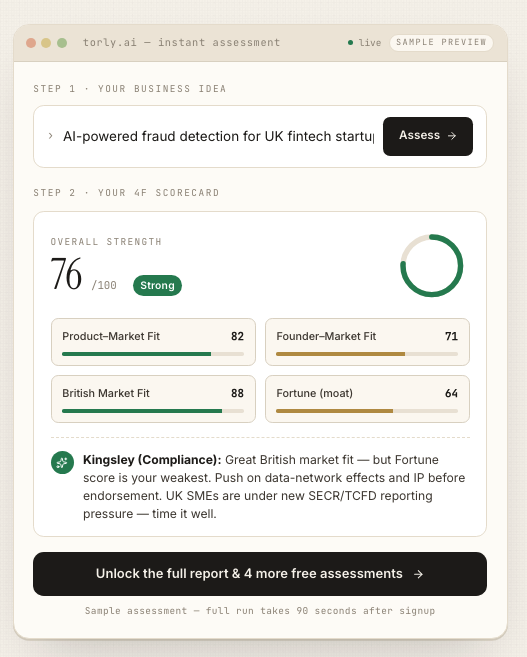
Torly.ai is built specifically to resolve these blind spots. It operates on three pillars of AI readiness:
-
Business Idea Qualification
– Evaluates compliance needs against current UK AI guidelines.
– Flags where transparency and ethics documentation is thin. -
Applicant Background Assessment
– Checks your experience against Home Office and endorsing body expectations.
– Advises on upskilling or partnerships to strengthen your profile. -
Gap Identification & Action Roadmap
– Generates a tailored plan to fill missing compliance pieces.
– Provides document templates and audit examples in line with best practice.
By integrating policy analysis with practical guidance, Torly.ai ensures your application ticks every box. You get real-time feedback on your AI governance framework, so you never face surprise queries from endorsers.
Here’s a tip: after drafting your risk assessment, use Torly.ai’s module to compare it against industry standards. Simple prompts will reveal unclear phrasing or missing metrics. Once corrected, your application is stronger.
For hands-on support when you need it most, don’t forget to Build your Business Plan NOW with our Desktop APP.
Key Benefits of Using Torly.ai for Visa Compliance
Real-time Feedback and Continuous Updates
With AI regulations in flux, you need a tool that automatically updates its compliance criteria. Torly.ai’s agents monitor policy shifts so your documents adapt overnight.
Tailored Business Plan Generation
Drafting a business plan can take weeks. Torly.ai reduces that to hours, embedding transparency statements and governance sections aligned with UK AI standards. When you hit “export”, you have a submission-ready plan.
Collaborative Review and Endorsement Simulation
Invite mentors or legal advisers to review your plan within Torly.ai. They can comment directly on AI-specific sections, ensuring nothing gets lost in translation.
For further planning ease, try our Your AI-powered assistant for business plan preparation to see the difference specialised AI makes.
Case Example: A Gap Analysis AI Success Story
Consider Sofia, founder of an AI health-monitoring startup. She struggled to justify her machine-learning model’s transparency to an endorsing body. After uploading her draft documents to Torly.ai:
- The system flagged missing bias-mitigation steps.
- It suggested a standard audit template and a two-page ethics overview.
- Sofia then ran a simulation of Home Office review, tweaking her plan accordingly.
Result? She received an endorsement letter within ten days. No reinterpretation needed, no follow-up questions.
Testimonials
“Torly.ai transformed my visa application process. The gap-identification tool highlighted blind spots I never even knew existed. I felt totally confident going into my endorsement interview.”
— John Thompson, CEO of HealthSense AI
“I was overwhelmed by AI compliance terms. Torly.ai’s step-by-step guidance made all the difference. My business plan was stronger and more credible.”
— Aisha Khan, Founder of GreenPredict
Embracing the Future of AI-Driven Visa Applications
The intersection of AI policy and immigration is only going to become more complex. Conducting a thorough Gap Analysis AI now will prepare you for upcoming regulatory changes. And when policy shifts, you need an assistant that shifts faster.
Torly.ai sits at that frontier. It’s more than a document tool; it’s a dynamic compliance partner that caters to entrepreneurs across Europe and beyond. Use it to craft a transparent, comprehensive, endorsement-ready application every time.
Ready to take control of your Innovator Visa journey? Gap Analysis AI Made Simple – Get Your Personalised Demo