Industry Specific Gap Analysis · June 16, 2026
From Clinical AI to Visa Prep: Evidence-Driven Gap Analysis Best Practices for Innovator Visa
Unveil how Torly.ai translates evidence gap analysis methodologies from healthcare AI to meticulously assess and strengthen your UK Innovator Visa submission.


Introduction: Bridging Evidence and Innovation
Ever wondered how top healthcare teams spot where AI falls short—and then fix it? That method, evidence gap analysis, has reshaped clinical AI fairness. Now imagine using the same rigour to nail your UK Innovator Visa application. With Gap Analysis AI, you can map out every missing piece, from proof of innovation to Endorsing Body criteria.
This approach isn’t guesswork. It’s data-driven. We pinpoint where your application lacks strength, apply clinical precision to visa prep, and serve you a bespoke action plan. Ready for a smarter route to endorsement? Gap Analysis AI-Powered UK Innovator Visa Application Assistant helps you cut through complexity and get compliant in record time.
Translating Clinical AI Fairness into Visa Prep
Evidence Gap Analysis: From Healthcare to Home Office
In healthcare, researchers conducted a scoping review of 467 studies to find fairness gaps in AI across medical fields. They catalogued missing data types, untested sensitive attributes, and imbalance in model performance. Think of your Innovator Visa plan like a clinical trial: every document, proof of funding and market research is a data point. Spot where endorsements slide because of weak evidence, then strengthen them.
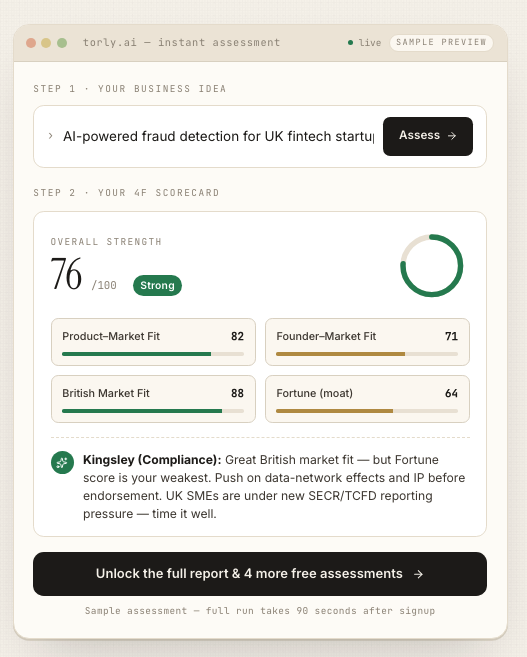
Applying that same structure, Torly.ai runs a three-layer analysis. First, it checks whether your business idea meets UK Home Office standards. Next, it vets your background—experience, expertise, prior ventures. Finally, it zeroes in on missing elements and flags them. This is modern Gap Analysis AI at its best, turning fuzzy requirements into a clear checklist.
Best Practices in Evidence-Driven Gap Analysis
Step 1: Comprehensive Context Mapping
Clinical AI fairness research shows that bias can pop up at any stage—from data collection to model output. In visa prep, bias is an oversight: you might overlook a required customer-validation report or mismatch financial forecasts. Start by mapping every Home Office criterion, endorsing body checklist and sector guideline. Create an evidence map that aligns each requirement with your supporting document. This context map is your diagnostic chart, just like in healthcare, revealing where you need more data or expert input.
Step 2: Attribute Profiling and Fairness Metrics
Healthcare teams classify attributes like ethnicity, age or gender to test group fairness. For Innovator Visa, your “attributes” are proof points: market traction, scalability, team structure. Assign a score to each attribute—scale of 1 to 5—and compare across criteria. Are you hitting 5 for innovation but just a 2 on financial robustness? That disparity is a gap. Use Gap Analysis AI metrics to quantify each shortfall. These actionable scores guide precise improvements and prioritise high-impact fixes. In doing so, you treat your application like a clinical AI model, striving for balanced performance across all fronts. Gap Analysis AI-Powered UK Innovator Visa Application Assistant
Implementing Gap Mitigation: Action Roadmap
When clinical researchers find gaps, they deploy pre-process, in-process and post-process strategies. The same trio works wonders for visa prep.
Pre-Process: Data and Document Preparation
Before building the application model, align your raw data. Gather market studies, patent details, customer interviews. Clean inconsistencies—update outdated figures, unify formats. If your business plan feels scattered, you need a focused tool. That’s where Build your Business Plan NOW comes in, offering AI-powered structuring so every section meets EB expectations. Think of it as resampling your dataset for fairness—only here, you’re resampling your narrative.
In-Process: AI-Assisted Analysis and Constraints
In clinical AI, in-process methods embed fairness constraints right into model training. Torly.ai does similar in real time. While you draft your pitch or financial model, our AI agents flag missing proof, suggest improvements, even propose market positioning tweaks. No more blind spots. Plus, with TorlyAI BP Builder APP, six specialised agents work concurrently, tackling everything from competitive analysis to legal compliance. It’s like adversarial learning for doc prep—continually refining until you hit the home run.
Post-Process: Submission Review and Follow-Up
After producing your business plan, enforce post-process checks. Clinical labs adjust thresholds to eliminate bias—Torly.ai conducts a final scan of your Innovator Visa pack. It reviews language clarity, ensures all endorsements and references align, and simulates Home Office feedback. Spot any last-minute omissions, then loop back quickly. And if you want local convenience, grab the TorlyAI Desktop APP to work offline or on secure systems.
Why Torly.ai Leads the Way
- 24/7 AI support keeps you moving, day or night.
- 95% success rate based on historic application data.
- Tailored documentation that aligns exactly with EB criteria.
- Average turnaround of 48 hours—you won’t waste weeks in limbo.
We’re not another visa consultancy. We’re a fairness engine, honed on clinical AI best practices, designed to deliver a compliant, competitive submission on the first try.
Conclusion: Your Evidence-Driven Edge
Bringing rigour from clinical AI fairness to visa applications changes the game. You get transparent gap analysis, quantified action steps, and AI-powered documentation all in one platform. Stop guessing about Home Office requirements. Start using Gap Analysis AI to map, measure and mitigate every risk.
Take the first step to endorsement success. Gap Analysis AI-Powered UK Innovator Visa Application Assistant