Academic Resources · August 12, 2026
From Academic Research to UK Innovator Founder Visa Success with Torly.ai
Transform academic research outputs into an endorsement-ready UK business plan using Torly.ai's multi-agent evaluation tools.

Turning Academic Research into Commercial Reality in the UK
Moving from the quiet halls of university research to building a high-growth business in the United Kingdom is a massive leap. Many founders hold brilliant PhD theses, groundbreaking patents, or novel software frameworks, yet they hit a wall when dealing with official scrutiny. Navigating the rules set out by the UK Border Administration requires more than just academic citations; it demands a clear, commercially viable business model that satisfies strict Home Office and endorsing body expectations.
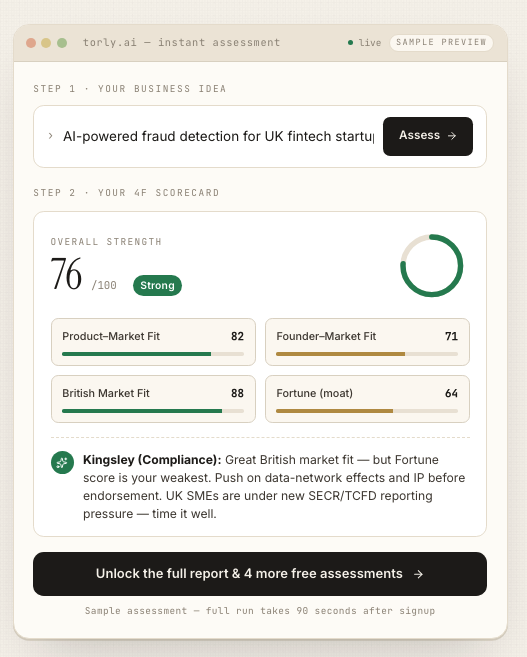
If you want to convert your intellectual property into a thriving venture, you need a structured strategy that bridges the gap between deep tech research and market execution. By using intelligent tools like the UK Border Administration AI-Powered Visa Assistant, academic founders can systematically evaluate their innovations, identify commercial gaps, and draft an endorsement-ready business plan that stands up to rigorous evaluation.
Why Academic Research Often Struggles with Endorsement Criteria
Academic papers excel at proving technical feasibility, novelty, and theoretical depth. However, endorsing bodies for the UK Innovator Founder Visa do not award visas for brilliant peer-reviewed literature. They evaluate three specific pillars:
- Innovation: Is the idea genuinely original and solving a real market problem?
- Viability: Does the applicant have a realistic plan, financial backing, and market validation?
- Scalability: Can the business grow significantly and create skilled employment across the UK?
When researchers apply, they frequently spend too much time explaining the complex underlying technology and too little time detailing customer acquisition, profit margins, and supply chain logistics.
The Historic Legal Context of Border Governance
The concept of administrative control over regional movement is not new. Historically, regulatory frameworks were put in place to manage commerce, trade, and residency across territories. For instance, centuries ago, the administration of the Scottish borders involved complex legal rules and local stewards to govern movement and economic activity. Today, modern governance relies on sophisticated criteria to filter who can establish enterprise within the country.
Understanding this balance between regulatory compliance and economic growth helps founders appreciate what endorsing bodies are looking for: structure, clear proof of intent, and total compliance with national economic goals.
The Three Fundamental Pillars of Visa Readiness
To transform your academic output into a robust business application, you must systematically test your thesis against commercial standards.
1. Business Idea Qualification
Your university thesis might demonstrate a 20% improvement in algorithm efficiency. That is impressive for an academic journal, but an endorsing body will ask: Who pays for this improvement? What is the size of the total addressable market? What are the entry barriers?
You must reframe your technical breakthroughs into customer value propositions.
2. Founder Capability Assessment
Endorsing bodies evaluate you just as strictly as your business model. Do you possess the leadership skills to run a startup? Have you built a balanced team? If you are a technical founder, you need to show how you will bridge the commercial, operational, and financial gaps in your skill set.
If you are looking to benchmark your readiness, you can test your proposal using the Build Your Endorsement Application with 6 AI Agents desktop software to catch missing operational details before submission.
3. Concrete Gap Identification
Where does your business plan fall short? Is your revenue projection overly optimistic? Have you ignored key legal frameworks or intellectual property protections? Finding these blind spots early saves months of re-applications and rejected fees.
How AI Intelligence Speeds Up Your Application
Preparing an endorsement application manually often takes months of back-and-forth consulting with legal experts, business advisers, and accountants. The traditional approach is expensive, slow, and prone to human error.
Modern AI evaluation systems change this dynamic completely. By utilizing dedicated multi-agent platforms, you can run continuous background checks on your business documentation 24 hours a day.
These intelligent agents analyze your inputs against real-world visa criteria, providing real-time feedback and clear roadmaps to fix weaknesses in your financial model or market strategy.
Halfway through your preparation, it becomes vital to check how your research aligns with strict regulatory standards. Working closely alongside the UK Border Administration business guidance tools ensures your documentation addresses every requirement set out by the UK government and its designated endorsing bodies.
Step-by-Step: Turning a Thesis into an Endorsement Application
To ensure a seamless transition from academia to entrepreneurship, follow this structured roadmap:
Step 1: Extract Commercial Intellectual Property
Identify the core asset of your research. Is it a unique algorithm, a material science breakthrough, or a specialized healthcare method? Isolate this asset from purely theoretical findings.
Step 2: Conduct Market Analysis and Competitor Audits
Map out existing market players. Highlight exactly where incumbent solutions fail and why your proposed venture will capture market share.
If you need automated help translating complex concepts into structured pitch decks and financial summaries, you can Build your Business Plan NOW using specialized tools built specifically for visa applicants.
Step 3: Define Financial and Hiring Metrics
The UK government values businesses that create high-value employment and contribute directly to the local economy. Outline your projected five-year revenue, explicit profit margins, and hiring plans for UK-based personnel.
Step 4: Validate Regulatory and Legal Compliance
Ensure your target industry complies with local laws, environmental regulations, and data protection rules (such as UK GDPR). Demonstrating awareness of legal obligations builds trust with endorsement panels.
Key Differences: Academic Writing vs Business Planning
| Aspect | Academic Thesis | Visa Business Plan |
|---|---|---|
| Primary Goal | Prove theoretical novelty & research validity | Prove market viability, scalability & profit potential |
| Target Audience | Academic peers, professors, journal editors | Endorsing bodies, business assessors, panel judges |
| Focus Area | Methodology, literature reviews, data analysis | Revenue models, customer acquisition, unit economics |
| Risk Perspective | Discusses theoretical limitations & edge cases | Mitigates commercial, legal & financial risks |
| Tone & Style | Passive voice, academic, lengthy explanations | Active voice, concise, direct, impact-driven |
Overcoming Common Pitfalls faced by Researcher Founders
Many researchers fail to secure endorsement because they fall into predictable traps during the preparation phase:
- Over-complicating the Technology: Writing 50 pages on deep learning architecture while giving only half a page to customer acquisition strategy.
- Ignoring Cash Flow Dynamics: Presenting research grants as sustainable business revenue instead of outlining actual product sales or enterprise licensing.
- Lack of Go-To-Market Clarity: Assuming that because a product is technologically superior, customers will buy it automatically without a sales funnel.
- Vague Team Structures: Failing to explain how key hires will be recruited to manage non-technical areas like marketing, legal compliance, and finance.
By using dynamic AI tools, you can stress-test your business narrative against historical criteria to clear these hurdles effortlessly.
Launching Your Venture with Confidence
Taking control of your entrepreneurial path in the UK requires equal parts technological innovation and administrative compliance. By using intelligent, evaluation-driven platforms, academic founders can turn complex research outputs into clear, professional, endorsement-ready business applications in a fraction of the traditional time.
To streamline your journey and safeguard your venture against standard application errors, leverage our TorlyAI BP Builder APP to build your comprehensive business narrative step by step.
When you are ready to complete your submission with complete peace of mind, make sure to verify your documents using the complete UK Border Administration application framework to maximize your chances of endorsement and long-term business success in the United Kingdom.