Country Specific Startup Visa Guides · August 12, 2026
Evaluating Founder Readiness for the UK Market with Torly.ai Intelligence
Leverage Torly.ai to rigorously evaluate your business viability, market fit, and founder capability before applying for the UK Innovator Founder Visa.


Deciphering UK Visa Readiness: The Ultimate Primer for Global Founders
Moving your business to the United Kingdom is a massive milestone, but securing endorsement for the UK Innovator Founder Visa requires far more than an exciting idea. Endorsing bodies (EBs) and the UK Home Office enforce strict criteria, demanding clear evidence of innovation, business viability, and dynamic scalability. Many international founders jump straight into drafting lengthy business plans without first assessing whether their operational capability aligns with UK market expectations. To navigate these requirements efficiently, entrepreneurs rely on advanced intelligence systems like Torly.ai to rigorously evaluate their business proposals and founder profiles before submitting formal applications. If you are exploring comprehensive Global Entrepreneur Visa Support to streamline your application strategy, early stage assessment is where your journey must begin.
This practical guide explores how founder readiness is measured, why traditional business plan models fall short, and how AI-powered analytical tools help clear complex immigration hurdles. By evaluating your core business metrics, identifying skills gaps, and leveraging real-time data, you can build a resilient entry strategy for the UK tech ecosystem. We will cover the core parameters evaluated by endorsing bodies, contrast the UK framework with other global immigration routes, and detail actionable steps to raise your success probability to 95 per cent.
The High Stakes of the UK Innovator Founder Visa
The UK business visa landscape has evolved significantly over recent years. The current Innovator Founder Visa route offers a direct pathway to establish cutting-edge operations in Britain, but it removed the explicit minimum capital requirement of £50,000, shifting focus heavily onto quality, market demand, and execution power.
Because official investment thresholds were relaxed, endorsing bodies now scrutinise business ideas with incredible precision. They are not looking for passive investments or run-of-the-mill services. They want high-growth ventures capable of hiring local talent, creating genuine intellectual property, and expanding internationally.
Failing at the endorsement stage costs more than just government application fees; it leads to lost momentum, delayed commercial launch, and reputational drag. Most rejections happen because founders fail to demonstrate deep knowledge of local UK competitor dynamics or cannot show how their personal background matches their proposed role.
Why Traditional Pitching Models Fail Endorsing Body Criteria
Standard business plans written for venture capitalists rarely work for UK visa applications. VCs often accept high risks in pursuit of speculative ten-fold returns. In contrast, immigration evaluators and endorsing bodies focus on risk mitigation, legal compliance, and operational feasibility.
Here is where traditional approaches break down:
- Generic Market Research: Citing massive global industry reports without local UK market segmentation.
- Unrealistic Financial Forecasting: Proposing hyper-growth without backing up customer acquisition costs or capital allocation details.
- Vague Intellectual Property Statements: Claiming a tech solution is unique without proving proprietary code or registered assets.
- Founder Profile Disconnect: Presenting a great business idea where the founder lacks the specific technical or managerial capability to execute it.
To solve this gap, founders need tailored analysis rather than static templates. Using specialised digital tools, you can run detailed checks on your underlying proposition before putting actual money on the line. Entrepreneurs preparing their submission documents can Build your Business Plan NOW using intelligent software designed around endorsement body expectations.
Innovation, Viability, and Scalability: The Holy Trinity
To secure an endorsement letter, your venture must pass three essential tests defined by the UK government.
1. Innovation
Is your business idea genuinely original? It must fulfill a distinct market need or create a compelling competitive advantage. Simply bringing a standard business model into a new city does not qualify. You must prove technological novelty, service differentiation, or process innovation.
2. Viability
Do you have the skills, resources, and capital to run this business successfully? Endorsing bodies evaluate your balance sheet, operational budgets, and financial projections. They assess your route-to-market plan, regulatory awareness, and target customer profiles.
3. Scalability
Does the business model demonstrate structured job creation and revenue expansion across the UK? You must present clear plans for structured hiring, market expansion, and sustained commercial growth over a three-year horizon.
Evaluating these three pillars simultaneously can feel overwhelming. Having access to responsive, 24/7 AI-Powered UK Innovator Visa Application Assistant guidance allows applicants to continuously benchmark their ideas against real-time regulatory trends.
Evaluating Your Founder Suitability and Skill Gaps
An innovative idea is only half the equation; the Home Office wants to know if you are the right person to build it. Founder readiness evaluation checks your work history, domain expertise, and leadership track record.
If you are a non-technical founder building a complex SaaS product, evaluators will question your capacity to deliver. Conversely, a brilliant software engineer without commercial management experience might struggle to prove market execution capability.
Identifying these gaps early allows you to bring on advisors, secure co-founders, or take targeted training to solidify your profile before formal submission.
Step-by-Step Guidance: Moving from Raw Idea to Endorsement
Preparing an endorsement application requires a systematic approach. Here is an actionable roadmap to follow:
- Initial Concept Evaluation: Stress-test your basic core idea against official guidelines to rule out fundamental disqualifiers.
- Competitor and Market Mapping: Analyse existing UK solutions to pin down your precise value proposition.
- Financial Modeling & Compliance: Build robust cash flow statements, profit-and-loss projections, and balance sheets aligned with UK tax and employment regulations.
- Founder Profile Audit: Match your CV and portfolio against your operational role in the business.
- Drafting the Business Plan: Construct a thorough document structured around endorsing body assessment criteria. You can leverage the specialized TorlyAI BP Builder APP to accelerate document creation using multi-agent reasoning.
- Final Mock Assessment: Conduct a comprehensive trial review to catch logic gaps before actual submission.
By working through these sequential stages, founders eliminate guesswork and avoid common application errors.
Comparing Global Startup Gateways: UK vs Korea Special Visa
Looking at how other nations structure entrepreneur pathways highlights the distinct strengths of the UK setup. For example, South Korea recently introduced the Startup Korea Special Visa to attract international innovators.
Unlike traditional point-based options like Korea’s D-8-4 visa, the Special Visa waives rigid degree and residency rules, evaluating founders primarily on idea feasibility, team capability, and market fit. This mirrors the UK’s shift towards qualitative assessment over rigid financial thresholds.
However, the UK Innovator Founder Visa offers distinct advantages, including direct permanent settlement (Indefinite Leave to Remain) pathways after just three years, access to London’s global financial hubs, and an established English-speaking regulatory framework.
Understanding how different global programs evaluate candidates helps founders choose the ecosystem that best accelerates their strategic goals.
Strategic Acceleration with AI Intelligence
Preparing a high-quality visa package used to take months of expensive back-and-forth consultation with legal advisors and business strategists. While professional legal oversight remains essential, AI reasoning platforms now perform initial technical audits in seconds.
Torly.ai acts as an intelligent readiness analyst, operating across three specialized layers:
- Business Idea Qualification: Running deep checks against current UK endorsing body standards.
- Applicant Background Assessment: Matching founder CVs against core business operations to prove capability.
- Gap Identification & Action Roadmap: Delivering tailored recommendations to strengthen financial structures, technology choices, and market positioning.
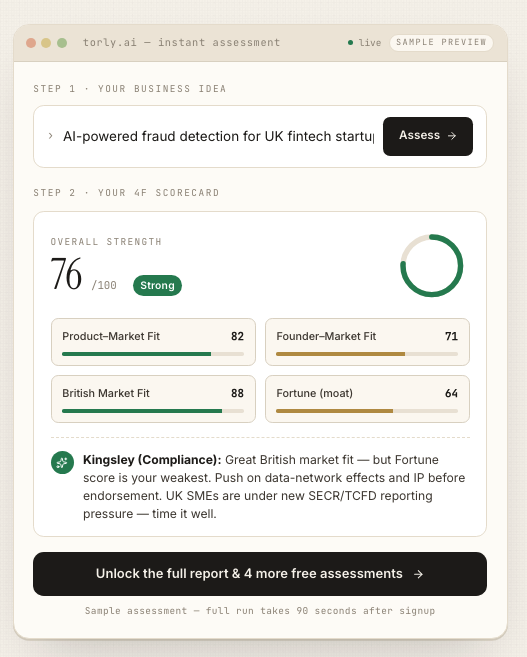
By utilising special reasoning models and six focused AI agents, entrepreneurs can refine their strategies, generate compliant business documentation, and secure dynamic risk scoring prior to formal submission.
Conclusion: Securing Your Future in the UK Market
Entering the UK market offers exceptional scale, capital access, and strategic exposure for ambitious entrepreneurs. However, navigating the endorsement criteria requires clear planning, thorough business modeling, and an honest evaluation of founder readiness.
Do not leave your visa approval to chance or rely on generic business templates. Take control of your application process by diagnosing gaps, refining your commercial strategy, and proving your operational execution capability early.
Ready to transform your venture into an endorsement-ready application? Connect with dedicated Global Entrepreneur Visa Support today to evaluate your business viability and unlock your path to the UK startup ecosystem.