Tax Policy Analysis · May 16, 2026
Dynamic Scoring Explained: From Tax Debates to Innovator Visa Business Model Success
Explore how dynamic scoring principles inform our Innovatorly Matrix, boosting your business model evaluation and UK Innovator Visa endorsement chances.


Introduction: How Dynamic Scoring Shapes Policy and Business
Dynamic scoring is a hot topic in tax policy. It pits static estimates (the quick back-of-the-envelope maths) against a more nuanced approach that predicts how policy changes ripple through an entire economy. Think of it as moving from a photograph to a short film. You see not just the immediate snapshot but the follow-on effects.
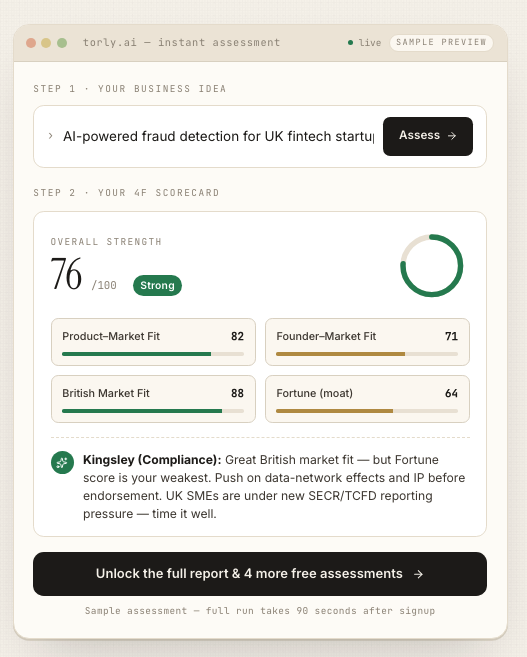
This same principle underpins the Innovatorly Matrix at Torly.ai, our advanced AI agent that evaluates your UK Innovator Founder Visa readiness. By forecasting how tweaks to your business plan drive market engagement, revenue potential and endorsement likelihood, you get a clearer picture of success. Explore dynamic scoring with our AI-Powered UK Innovator Visa Application Assistant
The Basics of Dynamic Scoring in Tax Policy
Dynamic scoring first gained traction in Washington debates. Traditional (static) scoring assumes no change in behaviour after a policy is enacted. Dynamic scoring adds a layer: it factors in how individuals and businesses react.
Key insights from the Bipartisan Policy Center’s explainer:
– Tax cuts may stimulate investment and hiring
– Increased economic activity can partially offset revenue loss
– The baseline choice (static vs dynamic) can swing projected budget impacts by billions
In practice, dynamic scoring relies on macroeconomic models. It assesses feedback loops and behavioural shifts. In simple terms: change one input and watch a chain of responses unfold.
Why Dynamic Scoring Matters for Entrepreneurs
You might think dynamic scoring is just for Congress. Not at all. Entrepreneurs can borrow the same lens when crafting a business plan. Why?
– Future proofing : You see how product pivots alter customer uptake
– Resource allocation : You predict hiring needs based on revenue curves
– Endorsement appeal : You show Home Office endorsing bodies you’ve tested scenarios
It’s about moving beyond “I think it will work” to “Here’s the data on how it scales under varying conditions.” That’s powerful when seeking a UK Innovator Founder Visa.
Introducing the Innovatorly Matrix: Dynamic Scoring for Visa Success
At Torly.ai we’ve distilled dynamic scoring into the Innovatorly Matrix, our proprietary evaluation framework. It mirrors tax-policy analysis but in a visa context. The Matrix:
1. Quantifies potential market impact
2. Maps founder expertise to venture milestones
3. Anticipates risks and corrective actions
Every entrepreneur’s idea is assigned a dynamic score. The higher the score, the stronger the case for endorsement. We factor in:
– Innovation levels
– Market readiness
– Team capability
This approach reduces uncertainty. You don’t just submit a static business outline. You submit a living model that adapts as input assumptions shift. Download BP Build Desktop APP
Multi-Layered Assessment: From Viability to Scalability
Our AI-Powered UK Innovator Visa Application Assistant executes three stand-out evaluations:
– Business Idea Qualification : Is it novel, viable, scalable?
– Applicant Background Assessment : Do you have the chops to deliver?
– Gap Identification & Action Roadmap : Where are the gaps and how do you close them?
Each layer refines the next. It’s an iterative, data-driven cycle. No more guesswork. Just insights.
Gap Identification & Action Roadmap
Once your dynamic score is live, Torly.ai flags specific enhancements:
– Technology stack upgrades
– Team composition tweaks
– Market entry strategy shifts
Then it generates a step-by-step plan. You get a clear route from draft application to endorsement-ready business plan. Practical. Concrete. Actionable.
Applying Dynamic Scoring in Your Application Strategy
Want to build your own dynamic scoring model? Here are the steps we use at Torly.ai and you can adapt:
1. Establish a baseline scenario
2. Identify key drivers (price, volume, cost structure)
3. Model behavioural responses (customer churn, adoption rates)
4. Simulate policy (or strategy) changes
5. Measure impact on revenue, hiring, market share
6. Iterate until the model stabilises
By doing this you uncover which levers to pull when. No more one-size-fits-all. Each assumption is stress-tested.
Apply dynamic scoring in your business model with our AI-Powered UK Innovator Visa Application Assistant
After rigorous testing, you’ll know exactly where to focus resources to hit growth targets and convince endorsing bodies.
Build Your Endorsement Application with 6 AI Agents
Real-World Impact: Case Examples
Imagine a fintech founder in Manchester. Their baseline forecast showed modest uptake in year one. Using dynamic scoring, they modelled:
– A 10% price reduction incentivising 25% higher sign-ups
– A targeted social-media push cutting acquisition cost by 15%
– A team expansion at month six boosting retention
The result? A revised dynamic score that jumped 35 points. Endorsing bodies saw a clear path to scale. Visa approved in record time.
Or consider a health-tech startup in Edinburgh. They used the Innovatorly Matrix to compare two product rollout strategies. Scenario A focused on premium features, Scenario B on volume. Dynamic scoring revealed Scenario B unlocked network effects that outperformed revenue projections by 40%.
Beyond Tax Policy: Broad Applications of Dynamic Scoring
Dynamic scoring isn’t limited to tax or visas. You’ll find it in:
– Public policy modelling
– Corporate budgeting
– Investment analysis
Anywhere a change in one area ripples across a system, dynamic scoring adds clarity. It moves you from gut feel to evidence-based decisions.
Conclusion: Embrace Dynamic Scoring for Visa Approval
Dynamic scoring turns vague forecasts into actionable intelligence. You get:
– A robust Innovatorly Matrix evaluation
– A clear roadmap to endorsement
– Confidence that your application rests on solid analysis
Ready to elevate your visa application? Use dynamic scoring to strengthen your application via our AI-Powered UK Innovator Visa Application Assistant