Government Immigration Services · August 12, 2026
Comparing Offshore Founder Permits with the UK Innovator Visa via Torly.ai
Evaluate global founder visa routes and secure your UK Innovator Founder Visa endorsement quickly with Torly.ai's AI desktop app.

Navigating Global Entrepreneur Visas and the UK Border Administration Framework
Choosing where to scale your technology startup is one of the most critical decisions you will make as an enterprise founder. International founder options range widely, from offshore permits in places like Bermuda to structured pathways in major European hubs. Understanding how different foreign frameworks measure up against the UK Border Administration guidelines for tech founders is vital if you want to avoid costly delays, missed deadlines, and sudden regulatory rejections.
While offshore jurisdictions often promise simplified tax setups and fast work permit applications, they rarely provide direct access to massive domestic markets, deep venture capital networks, or world-class talent pools. Conversely, securing entry through the Home Office requires meeting stringent standards evaluated by approved endorsing bodies. Navigating these requirements demands rigorous preparation, accurate data, and absolute alignment with official immigration policies before you submit your application.
Offshore Founder Permits vs the UK Innovator Founder Visa: A Strategic Comparison
Global immigration policies for entrepreneurs fall broadly into two main categories: lightweight offshore founder permits and criteria-heavy national innovation visas. Offshore regimes, such as Bermuda’s work permit frameworks, focus primarily on local presence, employment compliance, and financial solvency. They are designed to bring high-net-worth individuals or localized businesses onto the island.
In contrast, the UK Innovator Founder Visa targets disruptive tech creators and high-growth companies. The Home Office does not evaluate your commercial proposal directly; instead, they rely on designated Endorsement Bodies (EBs) to vet whether your business idea is genuinely innovative, commercially viable, and highly scalable.
| Comparison Feature | Offshore Founder Permits (e.g., Bermuda) | UK Innovator Founder Visa |
|---|---|---|
| Primary Focus | Local presence, employment tax compliance, foreign investment | Scalable tech, original intellectual property, disruptive innovation |
| Assessment Authority | Local Department of Immigration | Independent Endorsing Bodies & UK Home Office |
| Minimum Capital Requirement | Varies by work permit type and local banking criteria | No fixed minimum capital, but must prove financial viability |
| Settlement Pathway | Often restricted or subject to strict residency quotas | Direct route to Indefinite Leave to Remain (ILR) in 3 years |
| Market Potential | Highly localized or niche offshore trading | Direct access to the UK market and international VC funds |
While offshore permits offer speed, they often lack permanent residency options or access to large domestic economies. If your business model requires global growth, software engineering talent, and institutional capital, the UK pathway remains the premier destination. To ensure your business model aligns with these criteria, you can use the TorlyAI BP Builder APP to prepare your endorsement application.
Understanding the UK Border Administration Guidelines for Endorsement
The UK Home Office mandates that every applicant for the Innovator Founder Visa must receive a valid endorsement letter from an approved body before submitting their visa application. Dealing with the requirements of the UK Border Administration means satisfying three core tenets:
- Innovation: You must have a genuine, original business plan that meets new or existing market needs and creates a distinct competitive advantage.
- Viability: You must possess the necessary skills, knowledge, experience, and market awareness to run the business successfully.
- Scalability: You must present evidence of structured planning that shows potential for job creation and national or international market growth.
Failure to satisfy even one of these criteria results in immediate rejection. Endorsing bodies receive thousands of decks every year, and human reviewers spend mere minutes on initial scans. Your application must be flawless, watertight, and clearly structured right out of the gate.
Evaluating Business Ideas: Traditional Consultancy vs AI Evaluation
Historically, founders relied on expensive immigration lawyers and business consultants to draft their documentation. This legacy approach is slow, costly, and prone to human oversight. Traditional advisory firms frequently charge tens of thousands of pounds without offering any objective score on whether your application will pass endorsement scrutiny.
Modern LegalTech platforms have shifted this dynamic completely. By utilizing specialized reasoning engines, founders can now stress-test their business plans against real-time endorsing body benchmarks.
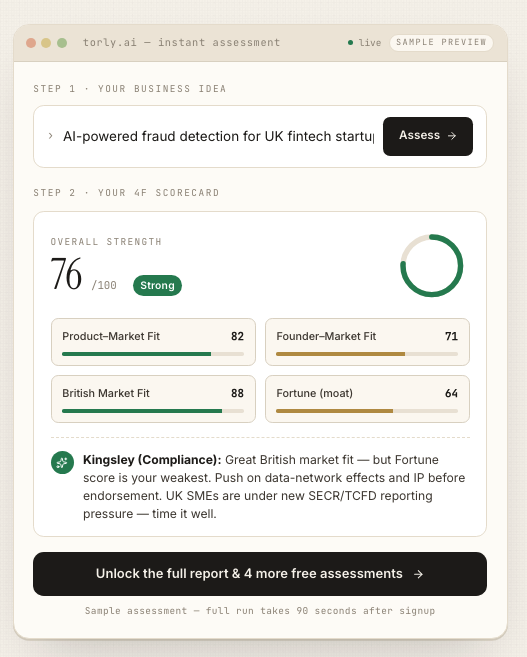
When you need immediate feedback on your startup proposal, you can build your Business Plan NOW using specialized AI tools that mirror the precise evaluation frameworks used by official government assessors.
How Torly.ai Deploys Specialized AI Agents for Visa Readiness
The UK Innovator Founder Visa application requires precise legal compliance and a robust commercial strategy. Torly.ai addresses this challenge by employing a multi-layered AI system consisting of specialized agents. Each agent handles a specific component of the visa evaluation process to ensure full compliance with immigration standards.
1. The Business Idea Qualification Agent
This agent analyzes your core proposition against historic Home Office decisions and endorsing body criteria. It checks whether your product is truly innovative or merely a copy of an existing service. It evaluates intellectual property potential, technology stack defensibility, and market differentiation.
2. The Applicant Background Agent
An innovative idea is meaningless if the founder cannot execute it. This agent evaluates your resume, professional background, track record, and leadership capability. It identifies gaps in your profile and recommends strategies to demonstrate founder fit to endorsement panels.
3. The Gap Identification and Action Roadmap Agent
Instead of simply telling you what is wrong, Torly.ai builds an actionable step-by-step roadmap. It pinpoints weaknesses in your financial forecasts, unit economics, target market size, or team structure, offering precise fixes before you submit your plan to reviewers.
If you are navigating complex rules governed by the UK Border Administration and immigration policy frameworks, automated evaluation removes guesswork and ensures complete technical compliance.
Step-by-Step Pathway to Securing Your UK Innovator Founder Visa
To maximize your chances of securing an endorsement on your first attempt, follow this structured roadmap:
Step 1: Objective Assessment
Before drafting a 50-page plan, run your core concept through an automated evaluation platform. Confirm that your business meets the official definition of innovation under current UK immigration rules.
Step 2: Financial and Viability Stress-Testing
Ensure your financial models reflect realistic operational costs in the UK. Factor in local salaries, corporate taxation, office expenditures, research and development spending, and client acquisition costs.
Step 3: Complete Documentation Assembly
Prepare all required supporting documents, including your pitch deck, detailed business plan, market research reports, CV, proof of funds, and evidence of non-dilutive grant funding or prospective client interest. You can leverage six specialized AI agents to generate an endorsement-ready plan that directly answers the specific metrics assessed by reviewers.
Step 4: Formal Endorsement Submission
Submit your completed plan to an approved endorsing body. Once approved, you will receive an official Endorsement Letter containing a unique reference number.
Step 5: Visa Application to the Home Office
Submit your formal visa application directly through the government portal, upload your biometric details, present your endorsement letter, and satisfy standard character and English language requirements.
Overcoming Common Pitfalls in Founder Visa Applications
Many global entrepreneurs fail to secure their UK visas due to easily avoidable mistakes. Understanding these traps is essential for a smooth application process:
- Generic Business Models: Submitting plans for standard agencies, traditional e-commerce stores, or basic consultancies without proprietary technology will result in immediate rejection.
- Unrealistic Financial Projections: Promising tens of millions in revenue in year one without clear customer acquisition strategies flags your application as unviable.
- Lack of Local Market Awareness: Failing to explain how your business will operate specifically within the UK market shows insufficient preparation.
- Ignoring Regulatory Frameworks: Failing to address data protection rules, financial service compliance, or local industry licenses creates compliance gaps.
By systematically addressing these points during document preparation, you eliminate risks early and position your startup for long-term international success.
Final Thoughts: Fast-Tracking Your Global Growth
Comparing offshore permits with national founder visas highlights a clear trade-off between simplicity and scale. Offshore options may work for boutique lifestyle operations, but the UK Innovator Founder Visa remains the leading choice for high-growth tech entrepreneurs aiming to build valuable businesses in a global financial hub.
Navigating immigration requirements does not have to be a multi-month ordeal filled with legal uncertainties. By using advanced AI systems, you can evaluate your business model, resolve profile gaps, and create an endorsement-ready application in days rather than months.
Ready to launch your enterprise in the UK? Check your visa readiness and secure your endorsement with Torly.ai today.