LLM Observability Tools · May 4, 2026
8 Must-Have Observability Tools to Evaluate Your Visa Application AI Agents
Learn how to monitor, trace and evaluate your AI-powered Innovator Visa assistant using the top observability platforms to guarantee accuracy and compliance.


Why You Need Performance Evaluation Tools for AI Visa Agents
AI agents are only as good as the metrics we use to judge them. When you’re depending on an AI assistant to guide entrepreneurs through the UK Innovator Founder Visa, you can’t afford blind spots. You need performance evaluation tools that catch hallucinations, latency spikes and drift before they derail an application. Think of them as safety nets below a high-wire act.
We’ll walk you through eight top-tier observability platforms. You’ll learn how they trace multi-step workflows, capture error logs, and funnel expert feedback into continuous improvement cycles. Along the way, we’ll show you how Torly.ai—our AI-Powered UK Innovator Visa Application Assistant—uses these same performance evaluation tools to ensure every business plan and endorsement application meets Home Office standards. Discover performance evaluation tools with our AI-Powered UK Innovator Visa Application Assistant
1. LangSmith: Deep Debugging for Complex Workflows
LangSmith is the Swiss Army knife of performance evaluation tools. It offers:
- Full-stack tracing of every tool call and intermediate step
- Annotation Queues where domain experts rate and correct runs
- LLM-as-a-judge evaluators for automated scoring
- Insights Agent that spots behaviour patterns by frequency and impact
Why it matters to your visa AI agent? You can see exactly why a recommendation loop got stuck or why a document retrieval step returned the wrong guideline. No more blind spots.
Pros
– Unmatched visibility into complex agent workflows
– Structured feedback loops for SME annotations
Cons
– Self-hosting locked behind an enterprise tier
– Requires subscription for BAA and extended support
2. Datadog LLM Observability: Unified Monitoring in One Pane
Already use Datadog for your server metrics? Its LLM Observability add-on ties AI latency and errors back to infrastructure health.
Key features:
– Correlates LLM spans with standard APM traces
– Agentless deployment via environment variables
– Pre-built Jupyter notebooks for RAG pipelines
– Basic metadata tagging (temperature, model parameters)
For AI-driven visa assistants, you get end-to-end visibility. If a compliance check stalls, you’ll know whether it’s a code issue or an under-powered VM.
Pros
– Familiar interface for teams in the Datadog ecosystem
– No new agents to install
Cons
– Lacks deep evaluation workflows
– Pricing can climb steeply at scale
3. Lunary: Lightweight RAG and Chatbot Insight
Building a chatbot to answer visa questions? Lunary plugs into RAG pipelines in minutes. It’s open-source, self-hostable, and free for up to 10k events per month.
Standout abilities:
– Rapid two-minute SDK integration (Node.js, Deno, Python)
– Embedding metrics and latency heatmaps for retrieval steps
– 30-day retention on the freemium plan
– Simple prompt playground for ad-hoc testing
Good for early-stage projects. But if you need granular role-based access or advanced evaluation, you might outgrow the free tier.
4. Helicone: Proxy-Based Observability with Caching
Helicone sits between your application and the LLM provider. Swap your API base URL, and voilà—observability, intelligent caching, and cost tracking.
What you get:
– Sub-millisecond latency overhead
– Support for 100+ models (OpenAI, Anthropic, AWS Bedrock)
– Automatic failover and caching to cut API spend
– Docker, Helm chart, or managed cloud deployment
If your visa agent makes dozens of document lookups per user, Helicone slashes redundant calls and keeps logs of every interaction.
Pros
– Minimal code changes required
– Strong open-source community
Cons
– Fewer evaluation features than dedicated platforms
– Complex Kubernetes setup for self-hosting
Torly.ai in Action: Building a Bullet-Proof Business Plan
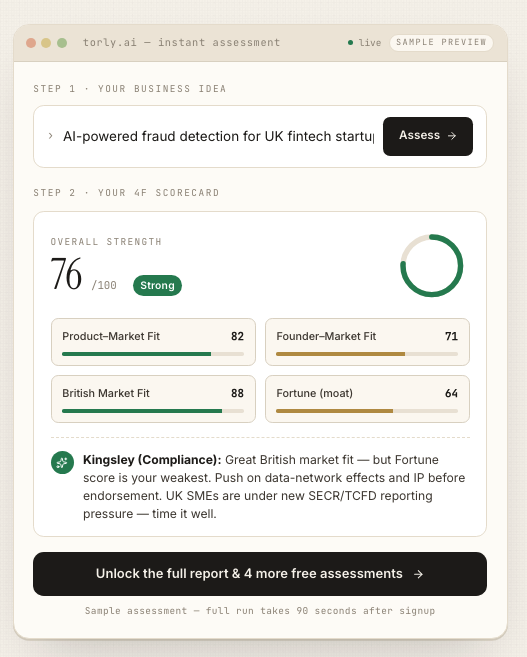
Torly.ai doesn’t just monitor AI behaviour. It uses these performance evaluation tools to assess your visa application readiness across three dimensions:
- Business Idea Qualification – Meets Home Office innovation and viability standards
- Applicant Background Assessment – Analyses entrepreneurial experience and endorsement likelihood
- Gap Identification & Action Roadmap – Generates concrete next steps
Need a hands-on tool to go from concept to endorsement-ready business plan? Build your Business Plan NOW
Once you connect your documents, Torly’s AI agents run multi-step checks, trace every logic path, and score each section. Experts can review traces in LangSmith or Datadog and feed corrections back into the platform.
5. Langfuse: All-in-One Open-Source Platform
Langfuse combines observability, prompt management, and evaluation into a single system. It’s MIT-licensed, so you can self-host and keep data under your roof.
Highlights:
– Drop-in LangChain callback handlers
– Unified dashboard for traces, prompts, and evals
– Support for Python and TypeScript SDKs
– Docker deployment with strong community engagement
For high-volume Innovator Visa applications, Langfuse gives you control without vendor lock-in.
Pros
– Holistic approach to performance evaluation tools
– Strong GitHub community
Cons
– Enterprise features cost from $2,499/mo
– Occasional self-host bugs in dataset runs
6. TruLens: RAG-Centric Evaluation Framework
If your AI agent relies heavily on retrieval-augmented generation, TruLens is built around the “RAG Triad” metrics:
- Context Relevance: Is the retrieved document on-point?
- Answer Relevance: Does the AI handle the question directly?
- Groundedness: Are responses anchored in provided context?
It plugs into Weights & Biases for experiment tracking, so your ML engineers can iterate quickly.
Pros
– Precise RAG evaluation at step level
– Chain-aware feedback functions
Cons
– Similarity scores can mislead on false positives
– Harder to define clear pass/fail thresholds
7. Arize Phoenix: Notebook-First Observability
For data-savvy teams that start in Jupyter, Arize Phoenix runs entirely locally. No vendor lock-in. No external dependencies.
Features you’ll love:
– OpenInference instrumentation (OpenTelemetry-based)
– Zero-setup local deployment in Docker or notebooks
– Cost tracking by token usage
– Multi-framework support (LangChain, LlamaIndex, Haystack)
Ideal for prototyping a visa-app assistant before you push to production.
Pros
– Fully local first approach
– Simplifies rapid experimentation
Cons
– Few default evaluation metrics
– Not a turnkey production monitoring solution
8. Portkey: High-Performance AI Gateway
Portkey earns its keep as a routing and fallback gateway. Observability is a bonus, with built-in logging and tracing.
Core benefits:
– Sub-millisecond latency with a 122 KB footprint
– Custom retry, routing, and load-balancing logic
– SDKs for JavaScript and Python
– Integrates with LangChain, Autogen, CrewAI
When your visa AI agent demands rock-solid uptime, Portkey handles retries and fallbacks on the fly.
Pros
– Lightning-fast gateway performance
– Simplifies complex management code
Cons
– Observability is secondary
– Limited native evaluation workflows
Halfway through your observability journey, it’s clear that not all performance evaluation tools are created equal. Whether you need deep debugging, RAG-centric metrics, or low-latency proxies, the right platform can transform your AI-powered visa assistant from guesswork into a compliance machine. Discover performance evaluation tools with our AI-Powered UK Innovator Visa Application Assistant
Bringing It All Together
Choosing an observability platform is about trade-offs. Do you prioritise:
- End-to-end traceability?
- Expert annotation workflows?
- Lightweight deployment or open-source control?
With Torly.ai, you don’t have to choose just one. Our AI-driven assistant already integrates these performance evaluation tools behind the scenes. You get a unified view of business plan quality, model reliability, and compliance readiness—24/7.
Ready to replace spreadsheets and Slack alerts with structured, AI-powered insights? Download BP Build Desktop APP
By combining the strengths of LangSmith, Datadog, Lunary and more, Torly.ai offers an unbeatable end-to-end solution for UK Innovator Founder Visa applicants. You’ll spot weaknesses in your pitch deck, fix logic gaps in scalability arguments, and generate a bullet-proof action roadmap—all in one place.
Discover performance evaluation tools with our AI-Powered UK Innovator Visa Application Assistant